My cousin Will Essigs recently sent me a book for Christmas. Sorry Santa, my transgression of pre-Christmas gift unwrapping can be explained: Will is one of the smartest, most hardworking people I know, and my desire to be a consultant is largely derived from his successful career. I could tell it was a book and knew the information inside was important. It was AI Superpowers – China, Silicon Valley, and the New World Order by Kai-Fu Lee, and it was very important.
I’m absolutely loving this book. It’s an analysis on the human-AI coexistence, predicting the disruptive shifts that define our AI-driven future. One of my favorite lines so far comes from Lee’s discussion with young students. He explains that, “we all want to know what AI Automation will mean for our jobs and for our sense of purpose… which people and countries will benefit from the tremendous technology… whether AI can vault us to lives of material abundance, and whether there is space for humanity in a world run by intelligent machines. We hear AI/ML all the time these days, but Lee believes this exploration is just in its infancy.
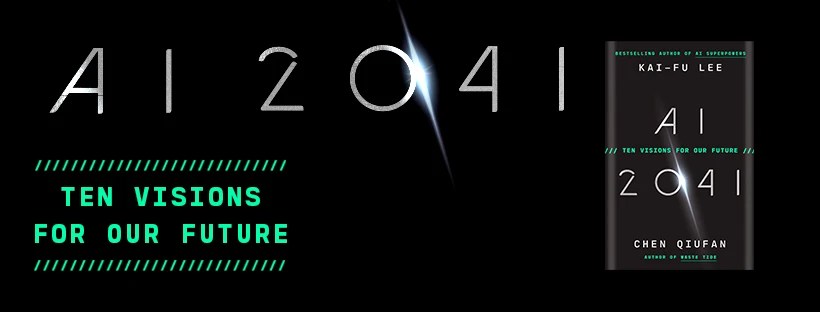
Obsessed with Lee’s writing, I began to look for more of his work. AI Superpower was written in 2018, and although still very current, there has been so much progression in the past 4 years. I was delighted to find that Lee released a new book just recently in September 2021 called AI 2040 – Ten Visions for Our Future.
This book is less analytical and more story telling. Lee and his ex Google co-worker / best selling science fiction author Chen Qiufan answer an imperative question: How will artificial intelligence change our world within twenty years? The book tells 10 gripping short stories, set twenty years ahead, about the future of AI. Although a few chapters in, Lee wrote something that really got me excited:
“AI will give us back our most valuable resource: Time. It will take over routine tasks and liberate us to do more stimulating or challenging jobs. Humans will work symbiotically with AI– with AI performing quantitative analysis, optimization, and routine work, while we humans contribute our creativity, critical thinking, and passion. Each humans productivity will be amplified, allowing us to realize our potential”
After Lee’s work, I plan to dive into some books that Alexandros Zenonos, PhD has recommended in his article Top 3 Books a New Data Scientist Should Read.
- Machine Learning by Tom Mitchell
- Elements of Statistical Learning by Trevor Hastie
- Pattern Recognition and Machine Learning by Christopher Bishop
 Zen Making Robots